

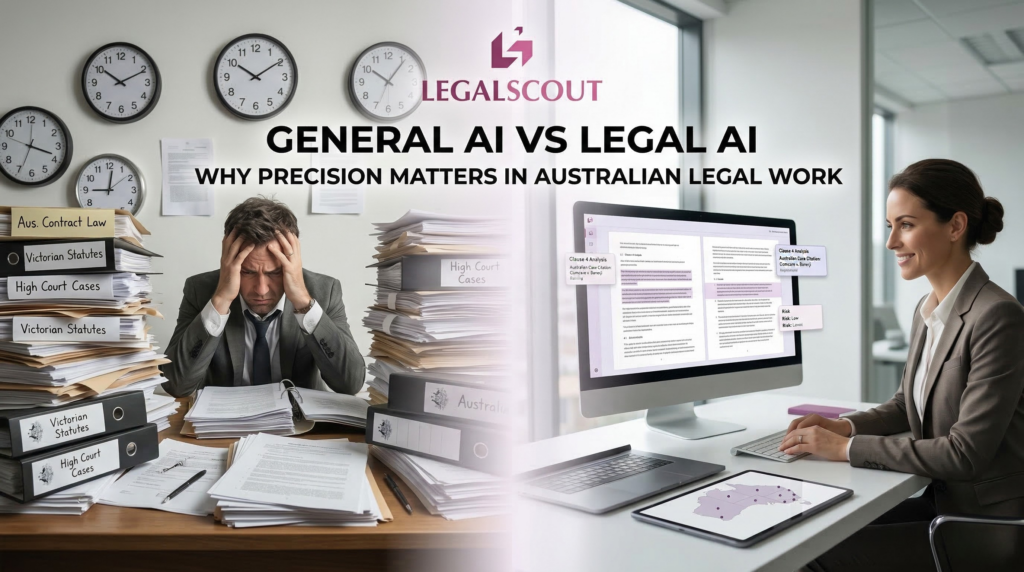
Legal AI is quickly becoming part of how professionals approach legal research, document drafting, contract review, and internal briefings. But not all AI tools operate at the same level.
General purpose platforms like ChatGPT can be helpful for framing an issue, surfacing broad considerations, and shaping a starting point. That makes them useful as strategic assistants. But when the work involves Australian Legal work such as corporate restructuring, directors’ duties, insolvent trading, safe harbour, or other Corporations Act related matters, the gap between general AI and specialist legal AI becomes much more significant.
That is where LegalScout stands apart.
LegalScout is built for Australian legal practice and combines legal research, document drafting, contract review, and document comparison in one private platform. It is designed for Australian SME law firms and built around the practical requirements of local legal work, with a strong emphasis on privacy and Australian hosted infrastructure.
The Difference Between General AI and Legal AI
A general AI tool is often strong at helping users think through a problem. It can outline issues, suggest possible angles, and help structure an initial response. That can save time in the early stages of legal work.
But legal work does not stop at structure. It depends on precision.
In practice, the difference becomes clear when an initial general AI response is reviewed through a specialised legal AI platform like LegalScout. A broad answer may be directionally correct, but still legally incomplete. It may miss a key statutory nuance, oversimplify a legal test, or fail to anchor the reasoning in the right Australian provisions and authorities.
That distinction matters because in legal decision making, “mostly right” is often not enough.
Why LegalScout Produces More Complete Legal Analysis
The biggest difference is depth.
Where a general AI tool may explain the topic at a high level, LegalScout is built to work from the Australian legal position. That makes it more useful for lawyers who need analysis tied to the right legal sources and practical legal workflows.
In practice, that means LegalScout can help with work such as:
- Identify the relevant Corporations Act provisions
- Connect legal reasoning to applicable Australian precedent
- Reduce the risk of relying on incomplete or overgeneralised analysis
- Produce work that is more useful for drafting, review, and internal decision making
This is especially valuable in areas where wording, thresholds, and duties need to be handled carefully. Directors’ duties, safe harbour, and insolvent trading are all areas where even a small omission can materially affect the quality of the advice or the confidence with which it is used.
Legal AI That Supports Actual Legal Workflows
One of the most practical advantages of specialist legal AI is that it does not just help with abstract research. It supports downstream legal work.
When analysis is specific, properly framed, and connected to the right statutory and case law basis, it becomes far easier to use that analysis in:
- Draft letters
- Transaction documents
- Board communications
- Briefing notes
- Internal legal summaries
LegalScout also positions itself as more than a point solution. Drafting, contract review, legal research, document comparison, and support for multiple file types including Word, Excel, PowerPoint, and PDF.
That matters commercially because the value of legal AI is not just in answering a question. The real value is in reducing the time spent turning that answer into work product.
Why Australian Context Matters in Legal AI
This is one of the biggest differentiators.
Many widely used AI tools are not built specifically for Australia. They may generate plausible sounding responses, but legal users still need to verify whether the reasoning maps correctly to Australian legislation, courts, and legal practice.
LegalScout is built for the Australian legal context and is intended to support Australian firms across areas such as commercial law, employment, litigation, IP, family law, and conveyancing.
For Australian users, that local focus changes the usefulness of the platform. It means the system is aimed at the law they actually work with, not just generic legal reasoning.
Better for Lawyers and Better for Non-Legal Stakeholders
Another important benefit of specialist legal AI is audience specific communication.
A legal team may need one version of the analysis for lawyers and a different version for executives, directors, operations teams, or commercial stakeholders. The challenge is not just simplifying the message. It is simplifying it without losing legal fidelity.
That is where specialist legal AI becomes especially useful. It can preserve the substance of the legal issue while helping reframe the explanation for different audiences. That makes it easier to move between legal analysis and clear commercial communication without losing accuracy.
Risk Reduction Is the Real Commercial Value
The biggest commercial benefit of legal AI is not convenience. It is risk reduction.
If a team acts on incomplete legal reasoning, the cost can be far greater than the time saved by using a fast but shallow tool. A specialist platform helps reduce that risk by improving the quality of the first pass analysis before external counsel is engaged.
LegalScout also places strong emphasis on privacy, governance, and Australian hosted infrastructure. For firms assessing legal AI, that matters because confidentiality and data handling are just as important as the quality of the output.
That positioning is significant for firms evaluating legal AI, because accuracy is only part of the decision. Data handling, confidentiality, and workflow integration matter too.
Final Thoughts
Legal AI is no longer just about speed. It is about whether the output is reliable enough to support real decisions.
General AI tools can still play a role in legal workflows. They are helpful for ideation, structuring, and early stage thinking. But when legal accuracy, Australian context, and defensible reasoning matter, specialist legal AI offers a very different level of value.
That is the position LegalScout is seeking to occupy: one private platform for drafting, contract review, legal research, and related legal workflows, built for the Australian market and better suited to work that demands context and precision.
For professionals working on legal matters where precision matters, that difference is material.
