

Coding Legal Documents with AI: How Automation Is Replacing Manual Clause Libraries
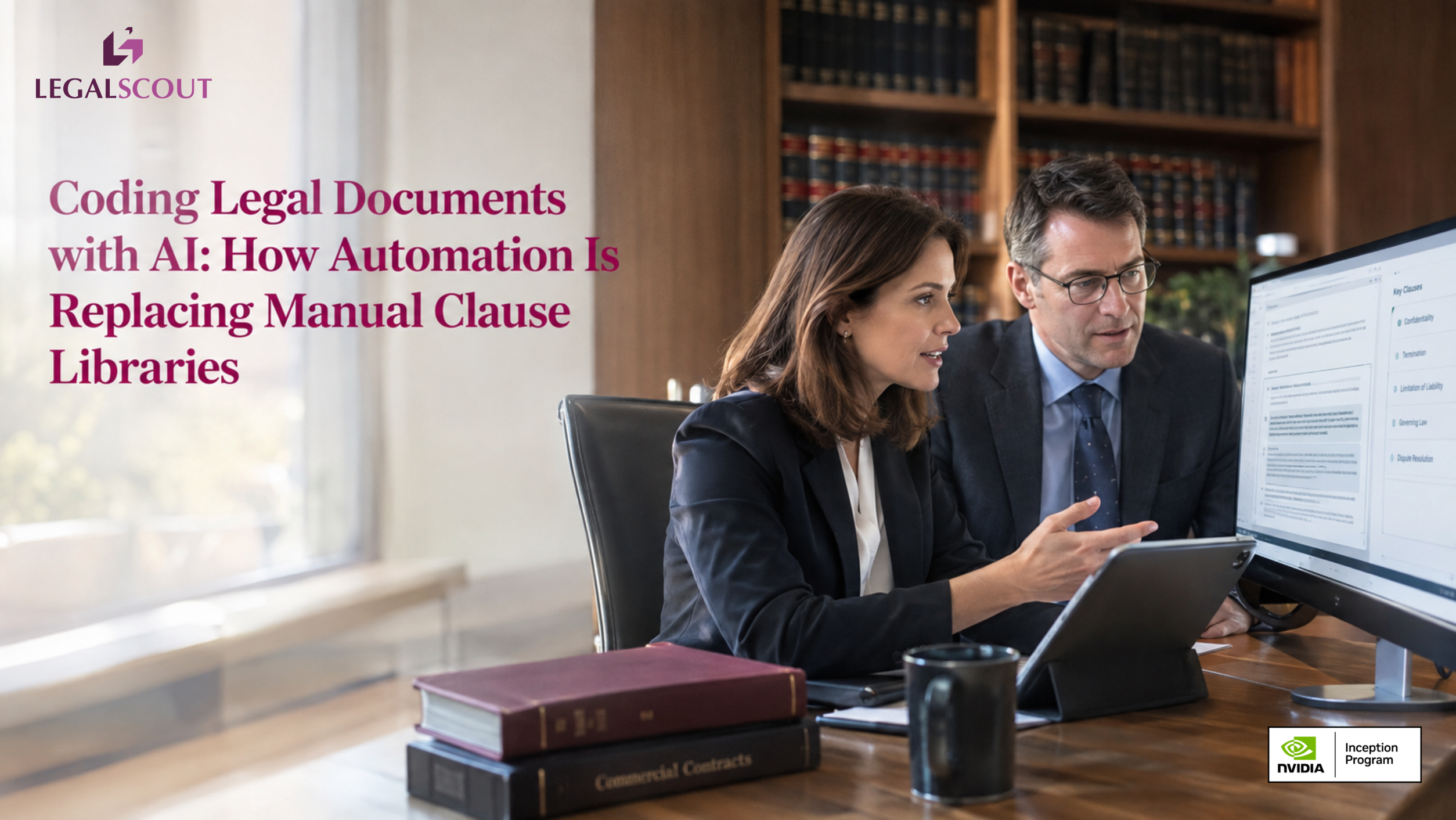
"Coding" a legal document has traditionally meant something very specific in legal practice: breaking a document into its component clauses, tagging each clause by type and function, and assembling documents from a library of pre-approved clause options. This approach - used by large firms with dedicated knowledge management teams - allows for standardised, quality-controlled document production at scale.
The problem is that it has always been inaccessible to smaller firms. Building and maintaining a clause library requires hundreds of hours of initial work, ongoing curation, and specialist knowledge management software. For sole practitioners and small teams, the investment has never been justified by the return.
AI is changing that equation entirely.
What "Coding" a Document Actually Involves
In knowledge management terms, coding a legal document involves decomposing it into its functional units - boilerplate recitals, operative clauses, definitions, schedules, and conditions precedent - and assigning each unit a classification so it can be retrieved, compared, and reused.
A well-coded clause library might contain 15 variations of an indemnity clause, each suited to a different risk profile. A lawyer drafting a services agreement would select the appropriate indemnity from the library, combine it with the relevant limitation of liability, termination, and dispute resolution clauses, and produce a first draft without writing a single new sentence.
This process delivers consistency and speed. It also creates a knowledge asset that improves over time as new clause variants are added and outdated ones retired.
Why Small Firms Could Never Compete
The barrier was always resources. A sole practitioner juggling client work, administration, and business development does not have 200 hours to code a clause library. Hiring a knowledge management consultant is prohibitively expensive. And off-the-shelf template libraries - while better than nothing - are generic, often based on UK or US law, and do not reflect the specific practice areas or client base of an individual firm.
The result has been a persistent capability gap: large firms produce standardised, high-quality documents efficiently, while small firms rely on ad-hoc templates, manual drafting, and accumulated Word documents saved in folder structures that only the original author can navigate.
How AI Replaces the Clause Library
AI-powered document drafting tools effectively automate the clause library concept without requiring the lawyer to build or maintain one. Instead of selecting from a pre-coded library, the lawyer provides the parameters of the document - the transaction type, the parties, the key commercial terms, the jurisdiction - and the AI generates a draft that reflects current Australian legal standards and best practices.
The AI draws on its training across thousands of legal documents to produce clause-level output that is contextually appropriate. An indemnity clause generated for a technology licensing agreement will differ from one generated for a construction subcontract - not because the lawyer selected a different option from a dropdown, but because the AI understands the different risk profiles and drafting conventions.
The Quality Control Layer
Generating a draft is only half the workflow. The other half is review. AI contract review tools scan the generated document for internal consistency, missing standard clauses, ambiguous definitions, and terms that may face enforceability challenges under Australian law.
This two-step process - generate then review - mirrors the workflow of a large firm where a junior lawyer drafts and a senior lawyer reviews, but compresses it into minutes rather than days. For a sole practitioner, it is the equivalent of having both a drafting team and a quality assurance team without any additional headcount.
Practical Impact for Sole Practitioners
The impact is measured in hours recovered and revenue unlocked. A sole practitioner who currently spends three hours drafting a shareholders' agreement from scratch can produce a reviewable first draft in 15 minutes using AI drafting, then spend an hour refining it. The two hours saved can be redirected to billable advisory work, client development, or simply achieving a sustainable work-life balance.
When combined with AI legal research for checking precedent and agentic AI for handling multi-step document workflows, the sole practitioner gains access to the same document production capability that previously required a team of three or four.
For SME firms growing beyond the sole practitioner stage, this capability scales without proportional cost increases - new team members use the same AI tools without requiring additional per-seat licences.
About LegalScout
LegalScout is a private legal AI platform built by Australian lawyers for SME law firms. Hosted entirely in AWS Sydney and aligned to the Privacy Act 1988 (Cth), LegalScout combines intelligent legal research, document drafting, contract review, and financial modelling into a single credit-based subscription - with no per-seat licensing. Book a demo to see how it works with your own documents.
FAQs
Q1: What does "coding" a legal document mean?
In legal knowledge management, coding means decomposing a document into its clause components, classifying each clause by type and function, and storing them in a structured library for reuse. It enables standardised, efficient document production but has traditionally required significant resources to establish and maintain.
Q2: Can AI replace a traditional clause library?
Yes. AI-powered drafting tools generate contextually appropriate clauses based on the document parameters the lawyer provides, effectively performing the same function as a coded clause library without requiring the lawyer to build or maintain one. See AI Legal Document Drafting.
Q3: How does a sole practitioner ensure quality when using AI-generated documents?
By combining AI drafting with AI contract review. The review tool scans the generated document for missing clauses, internal inconsistencies, and enforceability risks. The lawyer then applies professional judgment to the flagged issues.
Q4: Is AI-generated legal content specific to Australian law?
On platforms like LegalScout, yes. The AI is trained within an Australian legal context and generates output that reflects Australian legislation, case law conventions, and regulatory requirements - unlike generic AI tools that default to US or UK legal standards.