

Introduction
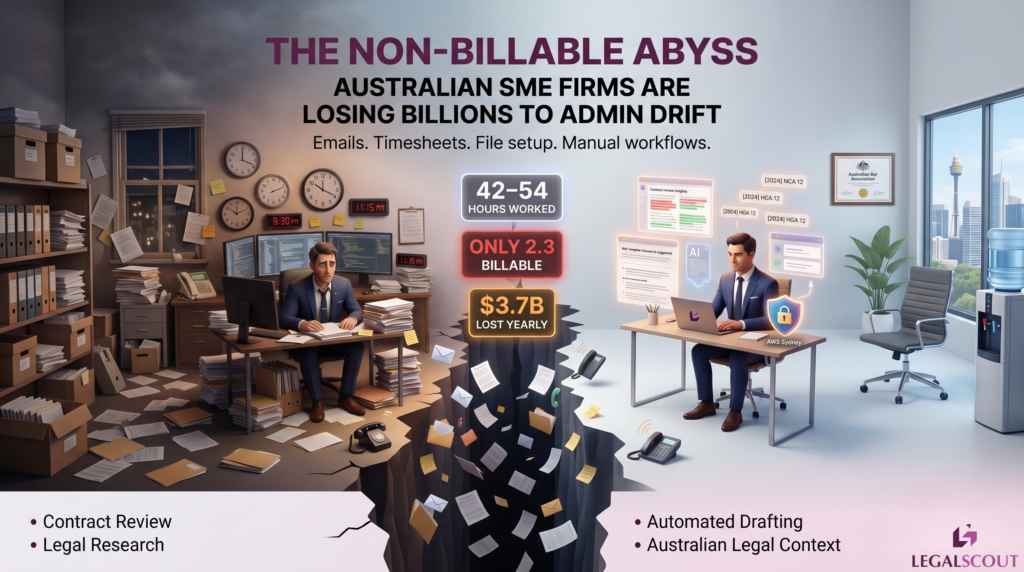
There is a quiet contradiction sitting at the heart of small and medium law firms across Australia. Lawyers in these firms are working harder than they ever have averaging between 42 and 54 hours a week and yet, on a typical day, only around 2.3 of those hours are actually billable. The rest is consumed not by complex legal thinking, advocacy, or client strategy, but by the steady, invisible churn of manual data entry, file sorting, time-entry reconstruction, and administrative drift.
This gap between hours worked and hours earned is not a productivity quirk. It is a structural problem and for SME firms running on tight margins, it is the single biggest threat to profitability, partner sanity, and long-term firm health.
This is the non-billable abyss. And it is wider than most principals realise.
The Numbers Don’t Lie
When Smokeball surveyed 134 small law firms across Australia, the findings were stark. Two-thirds of firms did not believe or were unsure that their billing accurately reflected the work their team had completed. Nearly half (46%) estimated they were failing to bill at least a quarter of their work.
Stretched across the small-law sector nationally, the lost revenue runs to an estimated $3.7 billion every year. Not lost to bad debt, not lost to write-offs at the negotiation stage simply never captured in the first place.
Clio’s Legal Trends Report, the most cited global benchmark for legal productivity, paints the same picture from a different angle. The average lawyer logs 2.6 to 2.9 billable hours out of an eight hour day a utilisation rate of just 33 – 37%. The remaining 60 plus percent disappears into a mix of administrative tasks (48%), business development (33%), and other non-billable activities.
Put plainly: for every hour a lawyer earns, they spend roughly two hours not earning. And the ones not earning are the ones that make them tired.
Where the Hours Actually Go
Ask any partner where the time disappears and the answer is rarely “court”. It is the smaller, atomised work the kind that never feels worth logging because individually it looks trivial.
Smokeball’s Australian data identifies the top time-drains with uncomfortable precision:
- 35% Administrative work. File creation, matter setup, document re formatting, filing correspondence, organising bundles, manual data entry across multiple systems.
- 25% Email. Triaging, forwarding, copy pasting between client portals and matter files, drafting holding replies.
- 24% Phone calls. Diary management calls, follow ups that should have been an email, intake conversations that never make it onto a timesheet.
- 4% Documents. The actual drafting and review work the thing lawyers were trained to do.
- 1% Meetings.
The pattern is brutal. The work most lawyers are paid handsomely to perform drafting, analysing, advising accounts for roughly one twentieth of where their time is being lost. The rest is administrative tissue that has accreted around the practice of law: necessary, but not legal work.
And because fewer than 25% of small firm lawyers in Australia fill in timesheets as they go, large portions of legitimately billable activity are reconstructed at the end of the day, the end of the week, or worse from memory at the end of the month. Industry research suggests that recording time at day’s end loses around 10% of billable hours; waiting until the next day loses 25%; by the end of the week, half the value is gone.
The “abyss” is not a metaphor. It is a measurable monthly leak.
The True Cost In Dollars and in People
The financial maths is bracing. At an average Australian small-firm hourly rate, recovering even one additional billable hour per day across a five lawyer firm equates to roughly $300,000 to $400,000 in additional annual revenue without taking on a single new client, hiring a single new staff member, or pushing rates upward.
But the human cost is, in many ways, more corrosive. Lawyers who spend the day shuffling files and reconstructing time entries are not doing the work they trained for. They are also not finishing on time. The 42–54 hour working week is, almost entirely, a non billable phenomenon the billable component is fixed by the eight-hour day, while the admin spillover is what stretches lawyers into evenings and weekends.
This is the engine of legal burnout. It is also one of the most common reasons mid-career lawyers leave SME firms for in house roles, or leave the profession altogether.
Why Generic Productivity Tools Haven’t Closed the Gap
Many firms have tried to solve this with practice management software, document-management systems, and more recently generic AI assistants. Some of these tools have helped at the margins. None has closed the abyss. Three reasons stand out.
First, fragmentation. A typical SME firm runs a matter through five or six unrelated systems: practice management, email, document storage, accounting, e signature, and a research database. Every handoff between them is manual. Every manual handoff is a leak.
Second, lack of legal context. Generic AI tools like ChatGPT or Gemini do not understand Australian law, Australian drafting conventions, or the specific structure of, say, a Section 32 statement or a family law property settlement. They produce confident output that often does not meet local legal standards which means lawyers spend as much time correcting AI output as they would have spent drafting from scratch.
Third, data risk. Pushing client information into public LLMs is not a productivity gain; it is a Privacy Act 1988 and professional-conduct exposure. The cost of a single confidentiality breach dwarfs any productivity dividend.
The result is that most SME firms either over-rely on tools that aren’t built for them, or avoid AI altogether and either path keeps the abyss open.
Closing the Gap: A Practical Framework
The firms beginning to close the non-billable abyss are doing four things consistently.
- They are automating the work that was never going to be billable in the first place. Matter setup, file organisation, document classification, routine correspondence, contract clause extraction the long tail of “drift” tasks can now be handled by legal specific AI in seconds rather than hours.
- They are using AI to compress, not eliminate, the work that is billable. Contract review, legal research, document drafting, and financial calculations in family law matters can be compressed by 60–80%. The work is still billable; it just costs the lawyer far less of their day.
- They are insisting on Australian context and Australian data hosting. A tool that cannot reliably apply Australian law, or one that processes client data through offshore public models, does not solve the problem it creates a different one.
- They are tracking utilisation as a leading indicator, not a lagging one. Firms that watch their billable to worked ratio weekly catch the drift early. Firms that look at it quarterly discover the leak only after a bad month.
Conclusion
The non-billable abyss is not inevitable. It is the cumulative result of legacy workflows, fragmented tools, and the assumption that admin overhead is simply the cost of running a law firm. None of that is true any longer.
The firms that will thrive over the next decade are not the ones that work the longest hours. They are the ones that recover the most hours from the abyss and put them back into client work, client relationships, and a sustainable working life for their lawyers.
That recovery is exactly what LegalScout was built to do. Designed from the outset within an Australian legal context, hosted on AWS Sydney infrastructure, and built specifically for SME firms and sole practitioners, LegalScout takes on the drafting, review, research, and calculation work that currently swallows the day without exposing your client data to public AI models.
If your firm is working 50 hours a week to bill 12, the problem isn’t your lawyers. It’s the abyss.
It’s time to close it.