

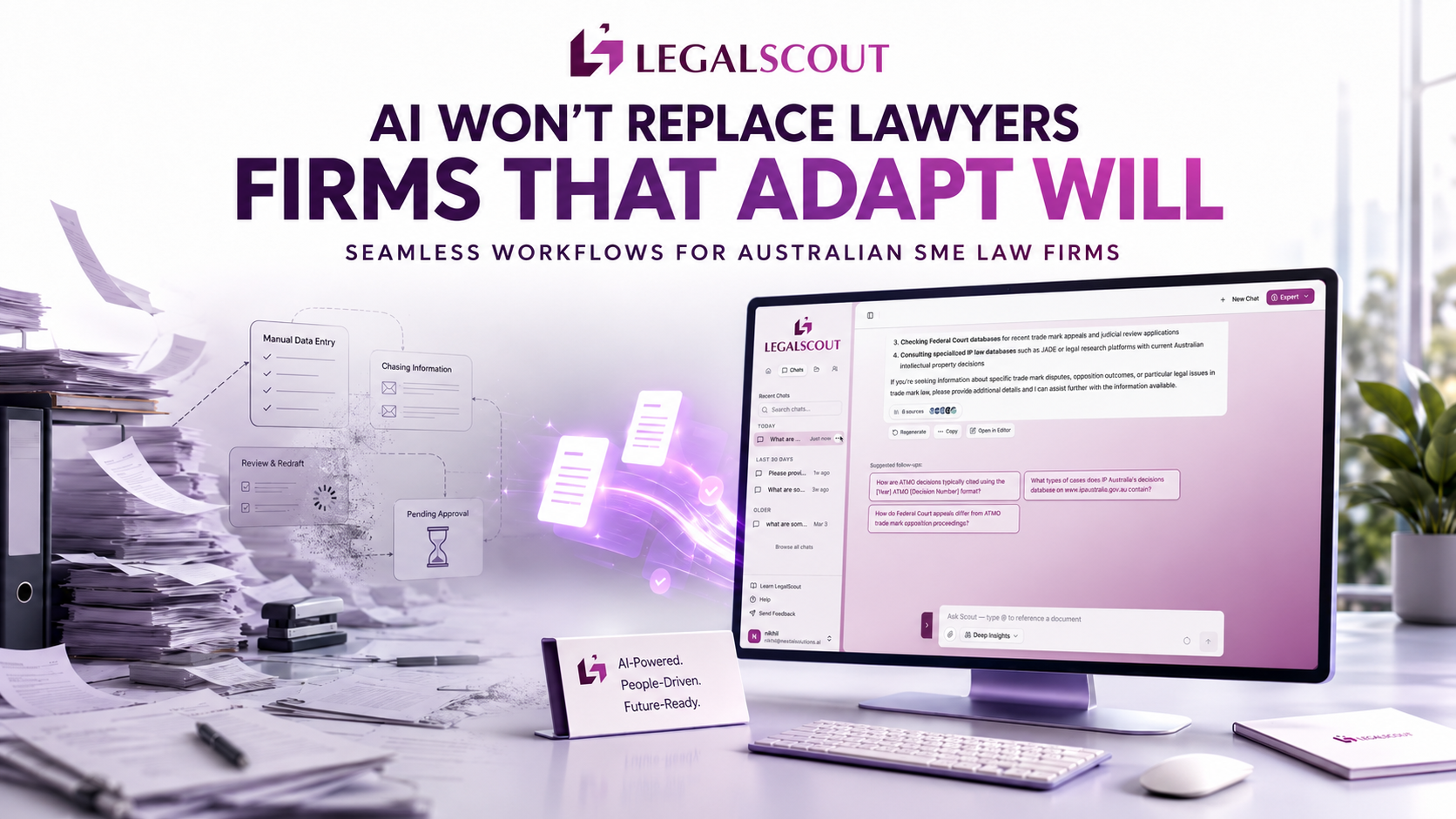
There is a version of your law firm where everything flows.
Where a new client matter opens and the relevant precedents, research, and draft documents are ready before the first client call ends. Where contract review doesn't derail an afternoon. Where your practice management system and your AI platform work together not against each other.
That version of your firm is closer than you think.
For Australian SME law firms, the conversation around AI has moved well beyond "should we use it?" The question now is far more practical: how do we integrate it into the way we already work without disrupting the systems, processes and people that keep our firm running?
This is the workflow question. And it is the most important question in legal technology right now.
The Problem With Disconnected Tools
Most Australian SME firms are already running some combination of practice management software, document management systems, billing platforms, and communication tools. Smokeball. LEAP. Actionstep. FilePro. Clio. The ecosystem is well established.
The problem is that AI has arrived as an addition to this stack not an integration within it.
Which means lawyers are switching between platforms. Copying and pasting between systems. Running research in one tool, drafting in another, storing documents in a third. The cognitive overhead of managing multiple disconnected tools is itself a form of administrative drift and it quietly consumes the time that AI is supposed to save.
A disconnected AI tool that saves 20 minutes of drafting time but requires 15 minutes of copy-paste and reformatting is not a productivity win. It is a productivity shuffle.
The firms that will benefit most from AI are not the ones that add AI to their existing chaos. They are the ones that integrate AI into a coherent, seamless workflow where the output of one step feeds naturally into the next.
What Seamless Integration Actually Means
Seamless workflow integration is not a technology feature. It is a practice design decision.
It means thinking carefully about where in your firm's workflow AI can deliver the most value and then building the connections that allow it to do so without friction.
For most Australian SME firms, there are five key workflow stages where AI integration delivers immediate and measurable impact:
1. Matter Intake and File Opening
The moment a new matter opens is the moment workflow either begins well or begins poorly.
In a seamlessly integrated firm, a new matter in your practice management system automatically triggers:
- A checklist of required documents and precedents for that matter type
- An AI-generated client summary based on intake information
- Draft initial correspondence ready for review and sending
- Relevant case law and statutory framework pre-loaded for the matter area
Instead of a blank file and a blank page, your lawyer starts with context, structure, and a head start.
LegalScout can be used at this stage to generate initial drafts and surface relevant Australian legal research the moment a matter is created giving your team a running start rather than a standing start.
2. Legal Research
Research is where disconnected workflows cost firms the most time.
A solicitor working on a family law property settlement matter might spend two to three hours searching across multiple databases, cross-referencing statutes, and validating citations before writing a single word of advice.
In a seamlessly integrated workflow, that research happens in parallel with matter preparation not before it. AI surfaces the relevant Australian precedents, statutes, and case law with full citations, ready to be reviewed and applied rather than found and retrieved.
The distinction matters. Finding is non-billable. Applying is billable.
LegalScout's research capability is built specifically for Australian legal context so the results are jurisdictionally relevant, properly cited, and ready to use in Australian legal documents without the risk of hallucinated overseas precedents slipping through.
3. Document Drafting
Drafting is the highest-value activity in most legal practices and the one most disrupted by the blank page.
In a seamlessly integrated workflow, drafting does not start from zero. It starts from a LegalScout generated first draft that reflects:
- The specific matter type and jurisdiction
- The relevant Australian legal framework
- Your firm's preferred drafting style and structure
- The specific client and transactional context
Your lawyer's role shifts from author to editor reviewing, refining, and applying professional judgement to a document that is already structurally sound.
This is not a minor efficiency gain. In practice, this shift can reduce drafting time by 60 to 80 percent on routine matters without reducing the quality of the final product.
4. Contract Review and Risk Analysis
Contract review is one of the most time-consuming tasks in commercial, property, and employment law practice. And it is one of the most amenable to AI augmentation.
In a disconnected workflow, contract review means a lawyer reading a document from page one to the end flagging issues manually, cross-referencing obligations, and producing a risk summary that takes hours to compile.
In a seamlessly integrated workflow, LegalScout reviews the contract, flags the risk clauses, identifies unusual provisions, and produces a structured risk summary in minutes. Your lawyer reviews the flags, applies their judgement, and advises the client.
The difference is not just speed. It is the quality of attention. A lawyer who has spent two hours reading a contract is tired. A lawyer who has spent 20 minutes reviewing AI-flagged issues is sharp.
Your clients deserve the sharp version.
5. File Notes, Correspondence, and Matter Closure
The tail end of a matter is where administrative drift is most insidious.
File notes that need to be written before they are forgotten. Follow-up correspondence that needs to be drafted and sent. Matter closure checklists that need to be completed. Billing narratives that need to be prepared.
In a seamlessly integrated workflow, AI handles the administrative scaffolding of matter closure draft file notes, draft correspondence, billing narrative suggestions while your lawyer focuses on the relationship, the advice, and the next matter.
The Integration Principles That Make It Work
Building a seamless AI workflow is not simply a matter of subscribing to a platform. It requires deliberate practice design decisions. Here are the principles that make integration work in practice:
Start with the highest-friction points Every firm has two or three workflow bottlenecks that consume disproportionate time. Identify them first. Integration works best when it addresses real pain rather than hypothetical efficiency.
Keep data in Australian jurisdiction Any AI integration that moves client data offshore even temporarily creates compliance risk under the Privacy Act 1988 (Cth) and the Australian Privacy Principles. Your integration stack must be built on Australian-hosted infrastructure from the ground up. LegalScout is hosted entirely on AWS Sydney infrastructure your data never leaves Australian jurisdiction.
Train your team on the workflow, not just the tool AI adoption fails when lawyers are handed a new tool without a new workflow. The integration is only as good as the process it sits within. Invest time in designing the workflow before deploying the technology.
Measure billable time recovery, not just time saved The metric that matters for SME firms is not how much time AI saves in abstract. It is how much of that saved time converts into additional billable hours, better client outcomes, or improved lawyer wellbeing. Track it deliberately.
Iterate based on real practice feedback Workflow integration is not a one-time project. It is an ongoing practice design conversation. The firms that get the most from AI are the ones that treat it as a living part of their practice reviewed, refined, and improved continuously.
What This Looks Like in a Real Australian SME Firm
Let's walk through a practical example.
A boutique commercial law firm in Melbourne four solicitors, one paralegal, one practice manager handles a mix of commercial contracts, business sales and acquisitions, and employment matters.
Before AI integration:
- Average drafting time for a shareholders agreement: 4–6 hours
- Average contract review time for a business sale: 3–4 hours
- Average research time per matter: 1.5–2 hours
- Non-billable administrative time per lawyer per day: 5–6 hours
After integrating LegalScout into their workflow:
- Shareholders agreement first draft generated in 15 minutes lawyer refines in 45 minutes
- Business sale contract reviewed and risk-flagged in 8 minutes lawyer reviews flags in 25 minutes
- Matter research surfaced with full Australian citations in under 2 minutes lawyer applies in context
- Non-billable administrative time reduced to 2–3 hours per lawyer per day
The result is not a different firm. It is the same firm with the same lawyers, the same clients, and the same quality of work operating with dramatically more capacity.
More matters handled. More billing. Less burnout. Better outcomes for everyone.
The Competitive Reality for Australian SME Firms
The firms that figure out seamless AI workflow integration first will not simply be more efficient. They will be structurally more competitive.
They will be able to take on more matters without hiring. They will be able to offer faster turnaround at the same or lower cost to clients. They will retain lawyers who are doing meaningful work rather than drowning in administrative overhead.
And the firms that delay will find themselves competing against practices that do the same quality of work in half the time.
This is not speculation. It is already happening in the Australian legal market. The question for your firm is not whether to integrate AI into your practice management workflow. It is how quickly you can do it well.
Why LegalScout Is Built for This
LegalScout is not a general-purpose AI tool adapted for legal use. It is a private AI platform built specifically for Australian SME law firms with Australian legal context, Australian data hosting, and Australian compliance requirements built in from the ground up.
It is designed to sit within your workflow not alongside it. To reduce the friction between research, drafting, review and advice. To give your lawyers back the hours that administrative drift has been quietly stealing.
And because it is hosted entirely on AWS Sydney infrastructure and aligned with the Privacy Act 1988 (Cth) and the Australian Privacy Principles your client data stays exactly where it belongs. In Australia. In your control.
Conclusion
Seamless workflow integration is not a technology project. It is a practice transformation.
It is the difference between a firm where AI is an additional tool that lawyers juggle alongside everything else and a firm where AI is woven into the fabric of how work gets done, reducing friction at every stage and converting saved time into billable capacity.
The non-billable abyss is not closed by working harder. It is closed by working smarter with tools built for the work, integrated into workflows designed for the practice, and hosted on infrastructure that protects your clients and your professional obligations.
That is what LegalScout is built to deliver.