

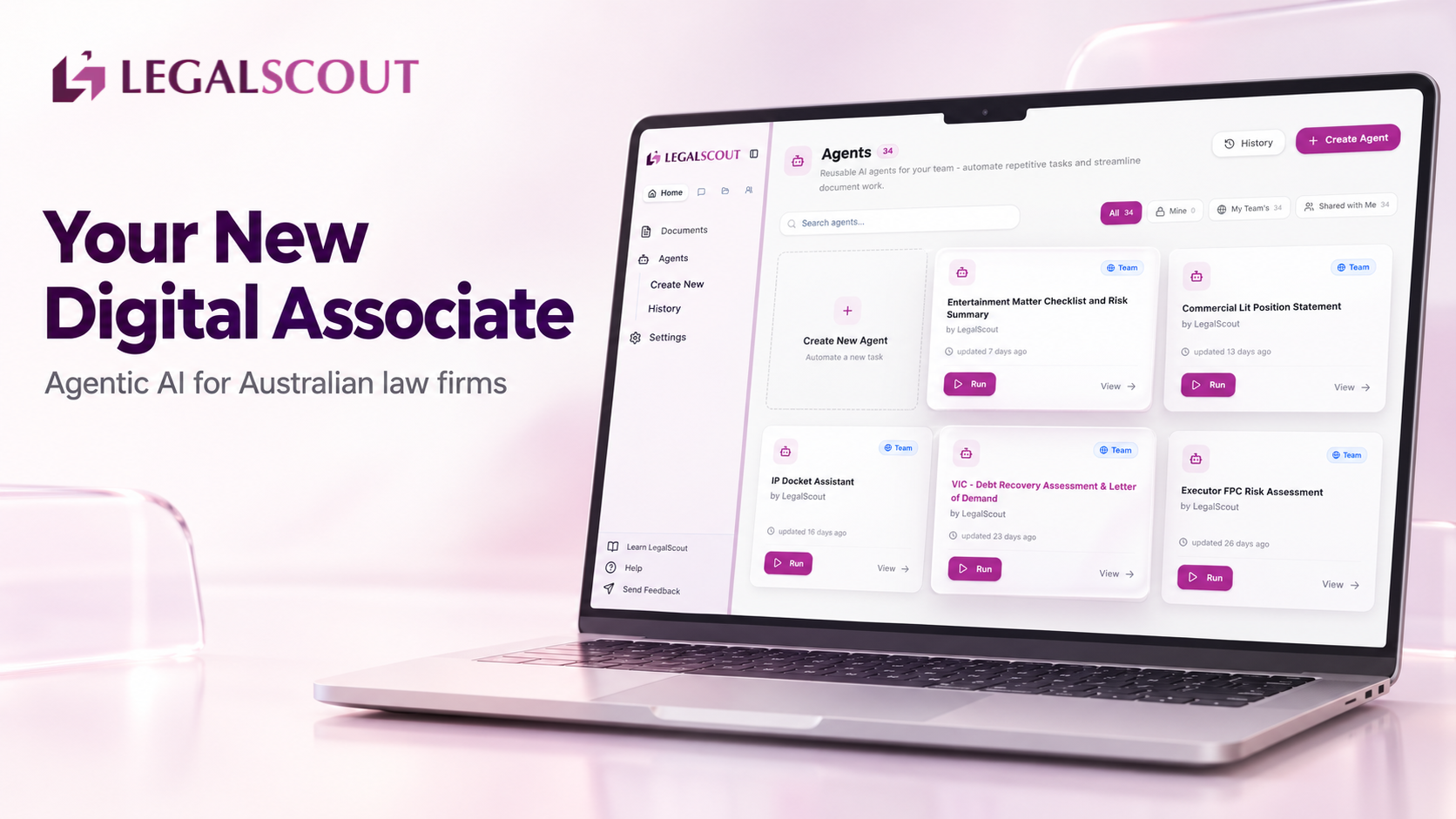
Agentic AI is artificial intelligence that plans and completes multi-step work towards a goal, instead of answering one prompt at a time. In a law firm, that makes it closer to a digital associate than a chatbot. You hand it a task, it works out the steps, does the reading and drafting, and returns work for a lawyer to review.
For small and mid-sized firms, that change matters more than any single feature. Most partners already know the problem: more matters than hours, and no budget for another junior. An associate that never runs out of capacity changes that equation, provided it is supervised like one.
What is agentic AI?
Agentic AI is software that is given an outcome, then decides the steps needed to reach it and carries them out. The word comes from agency: the capacity to act, not only to respond.
Four traits separate an agent from the AI tools most lawyers have already tried:
- It works towards a goal. You describe the result you want, such as a qualified enquiry or a reviewed contract. You do not write a prompt for every step.
- It plans. The agent breaks the job into tasks and decides their order.
- It uses tools. It can read documents, search case law, fill templates and update your practice management system.
- It knows when to stop. A well-built agent asks questions when instructions are unclear and hands work back at set checkpoints.
That last trait is what makes the digital associate label fair. A good junior does not guess when instructions are thin. They come back and ask.
How agentic AI differs from generative AI
Generative AI answers the question you ask. Agentic AI completes the task you assign. Both run on the same kind of language model, and the difference is who decides the next step.
What do you give it?
Generative AI assistant: A prompt
Agentic AI associate: A goal and the rules for reaching it
What does it do?
Generative AI assistant: Returns one response
Agentic AI associate: Plans and completes a chain of tasks
Who decides the next step?
Generative AI assistant: You
Agentic AI associate: The agent, until a checkpoint
Where does it fit in a firm?
Generative AI assistant: Research questions, summaries, first drafts
Agentic AI associate: Intake, triage, routing, draft and review from start to finish
What do you review?
Generative AI assistant: Every output
Agentic AI associate: The finished work and the exceptions
Neither replaces the other. A research assistant such as Ask Scout is the right tool when a client asks a question in a meeting and you need a cited answer that day. An agent earns its place when the same sequence of steps repeats across dozens of matters.
How agentic AI works inside a law firm
A digital associate follows the same loop a human associate does: take instructions, gather the facts, do the work, hand it up. With LegalScout's Agentic AI Associates, the loop looks like this.
- You define the workflow once. A partner or practice manager maps the process: what to ask at intake, what qualifies a matter, how work is prioritised and who receives it. The Planner AI helps turn that into a repeatable template.
- The Planner gathers what it needs. When a matter comes in, the Planner holds a structured conversation with the client or staff member. It asks the questions an experienced lawyer would want answered before starting work.
- The agent does the work. It applies your criteria, sends the matter to the appropriate lawyer and records it in your practice management system. For drafting tasks, it builds the document from your firm's precedents.
- The work lands with a lawyer. The agent hands over a matter summary or draft, with flags on anything that needs human judgement or partner sign-off.
Picture an employment enquiry that arrives at 9 pm on a Friday. By Monday morning the client has answered the intake questions, the matter has been classified and pre-screened for conflicts, and a summary sits with the right solicitor. Nobody worked the weekend.
What a digital associate can take off your plate
The best first jobs for a digital associate follow the same steps every time and rarely make it onto a bill. Administration, email and phone calls make up most of the time small Australian firms lose, according to Smokeball survey data we covered in The Non-Billable Abyss. That is where an agent pays for itself first.
- Client intake and qualification. Every enquiry gets a response and a first screening, including the ones that arrive after hours, so lawyers see the matters worth their time.
- Matter triage and routing. Incoming work is classified, prioritised and sent to the right team member. The record in Clio or Actionstep is updated without anyone retyping it.
- Conflict pre-screening and onboarding. The agent runs a first-pass conflict check, gathers the client's KYC details and prepares the engagement letter.
- Drafting and review. A single agent run can take a document from instructions to reviewed draft, using document drafting built on your own precedents and AI contract review against your playbook.
- Follow-up and knowledge retrieval. Post-matter follow-ups go out on schedule, and answers to recurring matter questions are pulled from the firm's own documents.
Few firms have got there yet. In the 2025 Victorian Lawyer Census, only 37% of lawyers reported using AI tools in their practice. The regulator's research centre lists triage and intake among the uses most of the profession has yet to try.
None of this is glamorous work. It is the work that slips when three lawyers are covering a workload built for five. The wider picture of legal AI for SME law firms follows the same logic: more capacity from the team you already have.
Where the lawyer stays in charge
A digital associate changes who does the work and leaves responsibility where it has always been: with the lawyer. That principle is known as human-in-the-loop, and Australian regulators have been plain about it.
In December 2024, the Law Society of New South Wales, the Legal Practice Board of Western Australia and the Victorian Legal Services Board and Commissioner issued a joint statement on AI in legal practice. It confirms that duties of confidentiality, independent judgement, competence and fair costs apply in full when AI is involved. Three working rules follow for any firm running agents.
- Supervise the agent like a junior. In the 2025 Victorian Lawyer Census, one lawyer described "treating AI as a junior employee who needs supervision". Review the output before it reaches a client, and verify anything you rely on.
- Give the agent process and keep the judgement. The regulators recommend keeping AI to work that carries less risk and is simple to check. Collecting intake details, classifying a matter and preparing a summary are far easier to check than legal analysis. Advice, strategy and the decision to act stay with a lawyer.
- Keep client data out of public tools. The joint statement warns lawyers against putting confidential client material into public chatbots. Yet the census found 65% of lawyers who use AI rely on general-purpose tools such as ChatGPT. We set out the risks in why public AI should never be used for legal work.
A private platform removes that last conflict. LegalScout runs AI inference inside AWS Sydney, never trains models on client content and keeps an audit log of every query. The detail is in the Trust Centre.
How to bring a digital associate into your firm
Start with one workflow, not a firm-wide program. Small firms see results fastest when the first agent fixes a problem everyone already complains about.
- Pick one high-friction process. Intake is the usual candidate. Enquiries wait, details get rekeyed and follow-ups slip.
- Write the rules down. List the questions you ask, the criteria that qualify a matter and who receives each matter type. This becomes the agent's instructions.
- Set checkpoints and a policy. Decide where a person must review before anything reaches a client. Put in writing the tools the firm has approved, who may use them and what data they may handle, as the regulators recommend.
- Connect your practice management system. An agent that updates Clio or Actionstep directly removes the copying and pasting that eats the time you saved. Our guide to integrating AI with practice management covers this in detail.
- Run it on real matters and measure. Track enquiries handled, response times and hours recovered. Then add the next workflow.
Put a digital associate to work
The quickest way to judge agentic AI is to run it on one of your own workflows. Start free with LegalScout: no credit card is needed.
LegalScout is a finalist for Best Use of Agentic AI (Start Up) at the 2026 Australian AI Awards. See how Agentic AI Associates handle intake, triage and routing, or book a 20-minute demo to watch a workflow run live.
About LegalScout
LegalScout is a private legal AI platform built by Australian lawyers for SME law firms. Hosted entirely in AWS Sydney and aligned to the Privacy Act 1988 (Cth), LegalScout combines intelligent legal research, document drafting, contract review, and financial modelling into a single credit-based subscription - with no per-seat licensing. Book a demo to see how it works with your own documents.
Frequently asked questions
What is agentic AI in a law firm?
Agentic AI in a law firm is software that completes multi-step work towards a set goal, such as qualifying a new enquiry or producing a reviewed draft. It plans the steps, uses the firm's documents and systems, and hands the result to a lawyer. The firm sets the rules and reviews the output, much as it would with a junior associate.
Will agentic AI replace junior lawyers?
No. Agentic AI takes over repeatable process work such as intake, triage, routing and first drafts. Australian legal regulators state that AI tools cannot advise or exercise professional judgement, so advice and supervision stay with lawyers. For a small firm, the practical effect is more matters handled by the same team, with juniors spending more of their day on legal work.
Is agentic AI safe to use with confidential client information?
It depends on where the AI runs. Regulators warn lawyers not to put confidential client material into public AI chatbots. A private platform that keeps data in Australia, never trains models on client content and logs every action lets a firm use agents within its confidentiality duties. LegalScout stores and processes all data in AWS Sydney and is aligned to the Privacy Act 1988 (Cth).
How is agentic AI different from generative AI?
Generative AI answers the question you ask, one prompt at a time. Agentic AI is given a goal and the rules for reaching it, then plans and completes the chain of tasks, stopping at set checkpoints for a lawyer to review. In a law firm, generative AI suits research questions, summaries and first drafts, while agentic AI suits repeatable workflows such as intake, triage and routing.